
This is an old revision of the document!
Table of Contents
The Keihin VD carburetor
 Here some details about the carburetors mounted on the Honda NTV 650 Revere. They are two Keihin VD carburetors marked as G4AACDt. They are constant velocity (CV) carburetors, that uses engine vacuum to operate a diaphragm-controlled slide, rather than a direct cable connection.
Nomenclature
- Jet needle
- Main jet
- Needle jet
- Slow jet
- Pilot screw
- Float valve
- Choke valve
- Air cut off valve
NOTICE: The terms slow, idle, and pilot are used more or less interchangeably in Honda manuals and Keihin carburetor documentation.


- Side view
- Air intake from the airbox.
- Choke valve seat.
- Pilot screw seat.
- Duct for the high intake vacuum that acts on the air cut-off valve diaphragm.
- Air cut-off valve: air in (normally open).
- Air cut-off valve: air out.
- Float chamber
- Main jet
- Slow jet
- Starter jet (choke/enrichment jet)
- Float valve
- Breath hole
- Vacuum chamber
- Air intake from the airbox.
- Starter (choke enrichment) air supply passage.
- Air intake for the air cut-off valve: normally open. It closes on deceleration (high rpm + throttle closed).
- Air intake for the slow jet.
- Air intake for the choke.
- Small vent that connects the chambers above and below the diaphragm: it acts as a vacuum/pressure control and damping system.
- Airbox view
- Air intake for the pilot and the air cut-off valve circuits.
- Engine view, bottom
- Primary pilot outlet port. This is the main idle fuel outlet, controlled by slow jet and pilot screw.
- Pilot progression ports. They provide staged extra fuel during throttle opening.
- Engine view, top
- Starter (enricher) outlet port and vacuum pickup port that operates the air cut-off valve.
- Slide, diaphragm, needle
- Slide lift holes: vacuum bleed holes that control how quickly pressure changes reach the above diaphragm chamber.
- Float bowl
- Drain screw.
- Drain conduct.
Functioning
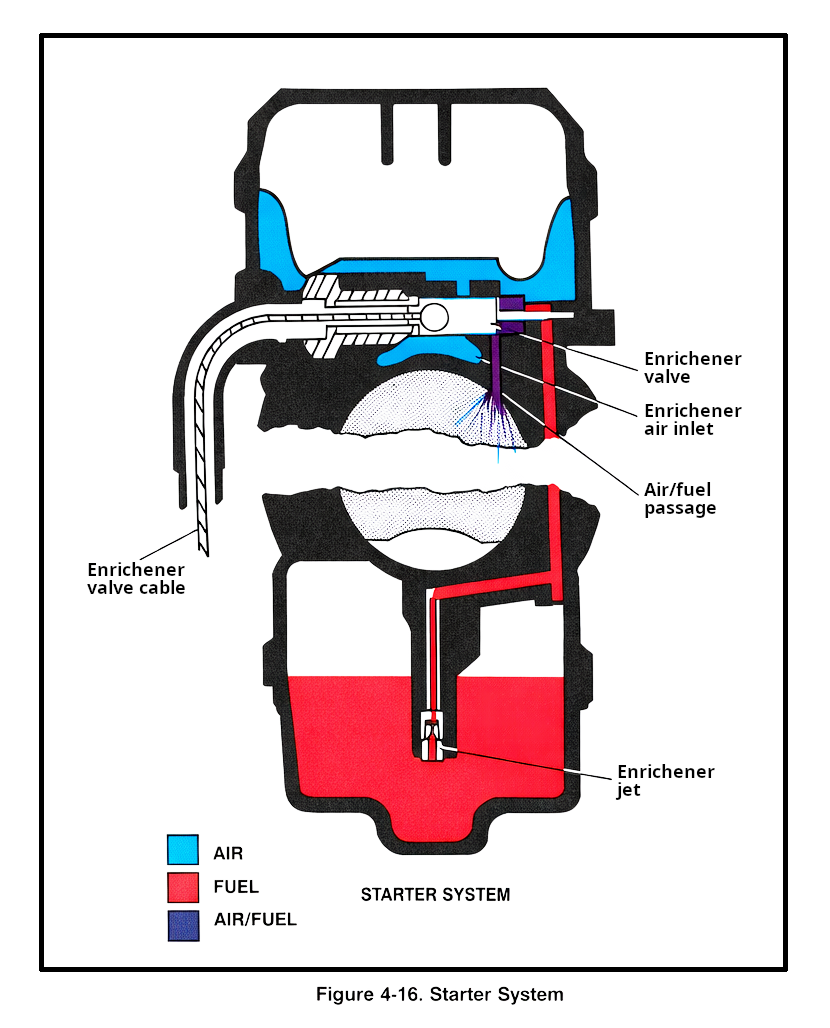
Starter System (Figure 4-16)
The starting circuit consists of a cable actuated starter valve and converging fuel and air passages in the carburetor body.
Fuel metered through the enrichener jet is directed upward through a passage to the valve chamber. The sarter valve opens the fuel passage to the carburetor venturi (vacuum side) when the enrichener knob is pulled outward. Air fom an opening in the carburetor inlet is directed to the valve chamber, where it mixes with incoming fuel.
Low pressure, (vacuum) created by the downward stroke of the engine pistons, causes the higher pressure in the float chamber to force the fuel/air mixture through the fuel/air outlet passage in the carburetor venturi.
The pilot screw
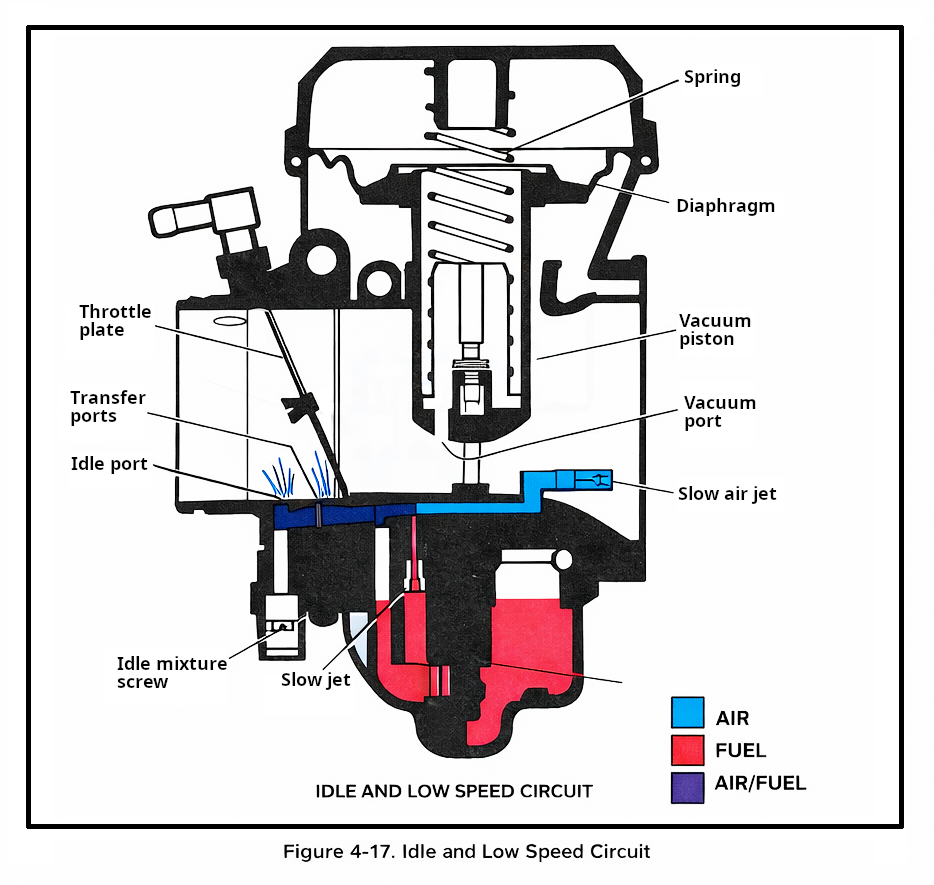
The Pilot screw is on the engine side of the carb, located after the pilot jet, it is a fuel screw.
- Turning it IN (tightening clockwise) reduces fuel flow, leaner mixture
- Effects:
- Harder cold start.
- Lower idle speed.
- Possible hesitation off idle.
- Lean deceleration popping.
- Turning it OUT (loosening counterclockwise) increases fuel flow, richer mixture
- Effects:
- Smoother idle.
- Better throttle pickup.
- Easier starting.
- Reduced decel popping.
The air cut off valve
